Several years ago, Graham, professor of international relations in James Madison College at Michigan State University, led a study abroad program in Greece and Turkey where he connected with Suhnaz Yilmaz, professor of international relations at Koç University in Istanbul.
The partnership established through education abroad resulted in numerous collaborations between the two over the years. As the pandemic shuttered doors and travel came to a halt, Graham and Yilmaz realized the time was ripe to begin working on a book they had been discussing.
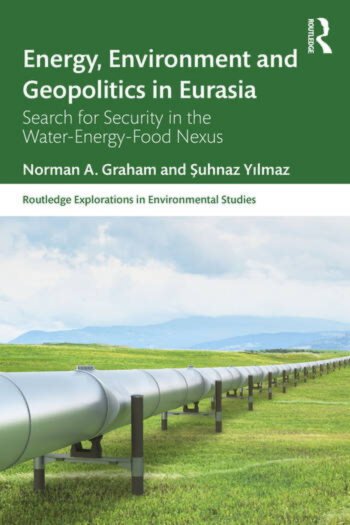
Published earlier this year by Routledge Explorations in Environmental Studies, “Energy, Environment and Geopolitics in Eurasia: Search for Security in the Water-Energy-Food Nexus,” provides an analysis of the energy relationship among various Eurasian nations and Europe.
Much of the book — the 11th for Graham — evolved from student experiences researching fisheries and water quality in the Black Sea region, Eastern Mediterranean and Caspian Seas. When Vladimir Putin invaded Ukraine two years ago, Graham and Yilmaz’s research became even more relevant.
“Putin’s invasion of Ukraine was surprising, and that turned some of the focus,” Graham said. We could see some of these relationships building, even prior to Putin’s presidency in the late 90s; Azerbaijan, for example, was establishing relationships with Western Europe and China.”
Historically, Russia was flush with energy capital. The sanctions imposed on Russia, Graham says, have been a game changer for Eurasian nations like Uzbekistan and Kazakhstan.
“Suddenly these countries were of greater interest because they were behaving more independently, which offered us an incentive to get the book done sooner than originally planned,” said Graham, who is also a core faculty member and former director of Michigan State’s Center for European, Russian and Eurasian Studies, or CERES.
Putin’s focus on Ukraine resulted in changes in other nations’ dependency on Russian resources, including security support.
“China and Europe are potential winners here as their relationships with Central Eurasia have changed in important ways,” Graham said.
"Energy, Environment and Geopolitics: Search for Security in the Water-Energy-Food Nexus" was published by Routledge Explorations in Environmental Studies early this year.
In the first few chapters, Graham and Yilmaz discuss the “unintended consequences” of the Russian invasion: European nations banding together to condemn Putin’s actions, leading to their new commitment to change energy systems and reduce their reliance on fossil fuels. With the loss of European dependency, both China and India have been purchasing Russian oil at a fraction of the old prices.
“Even if the war ended tomorrow, there would be some reluctance to mend relationships and dependency on Russian resources,” said Graham.
Changing energy relationships has resulted in improvements managing food security, water security and sustainable energy practices.
“We cannot get away from the geopolitics. We examine environmental sustainability, drought conditions, flow of rivers — who gets what river water for irrigation,” Graham said.
The interconnectedness of the issues identified in the book’s title provided opportunities for Graham and Yilmaz to partner with other units across Michigan State’s campus.
Jiaguo Qi, professor in the Department of Geography, Environment and Spatial Sciences; and Steven Pueppke, professor emeritus in the Department of Plant, Soil and Microbial Sciences, developed a project on the water-food-energy nexus that Graham worked on –co-publishing with Central Asia partners on the sustainability of inland fisheries and water resource sharing challenges.
Students in Graham’s MC 221: International Relations II and MC 328: Russian Foreign Policy will find “Energy, Environment and Geopolitics in Eurasia,” very relevant as the former deals with the sustainability of economies in climate change and the nexus, while the latter course explores the geopolitics of the former Soviet Union and its relationship with Europe and Asia.
Future publications are already in the works as Graham continues to examine the same region with his research assistants Maren Nicolaysen (IR ’24) and Rachael Lee (IR ’26).
“We are looking at the same region, studying cross-water river flows and the impact of certain dams on the environment, food security and energy generation,” said Graham.
“This would likely include the Rogun Dam in Tajikistan, The Kapchagay Reservoir Dam in Kazakhstan, the Volga River Dam near Volgograd, Russia, but the project might also include dams and rivers in the greater Middle East such as the GAP dams on the Tigris and Euphrates Rivers in Turkey that affects the water flow to Iraq and Syria, and the Grand Renaissance Dam on the Nile River in Ethiopia that affects water flow to Sudan and Egypt.”