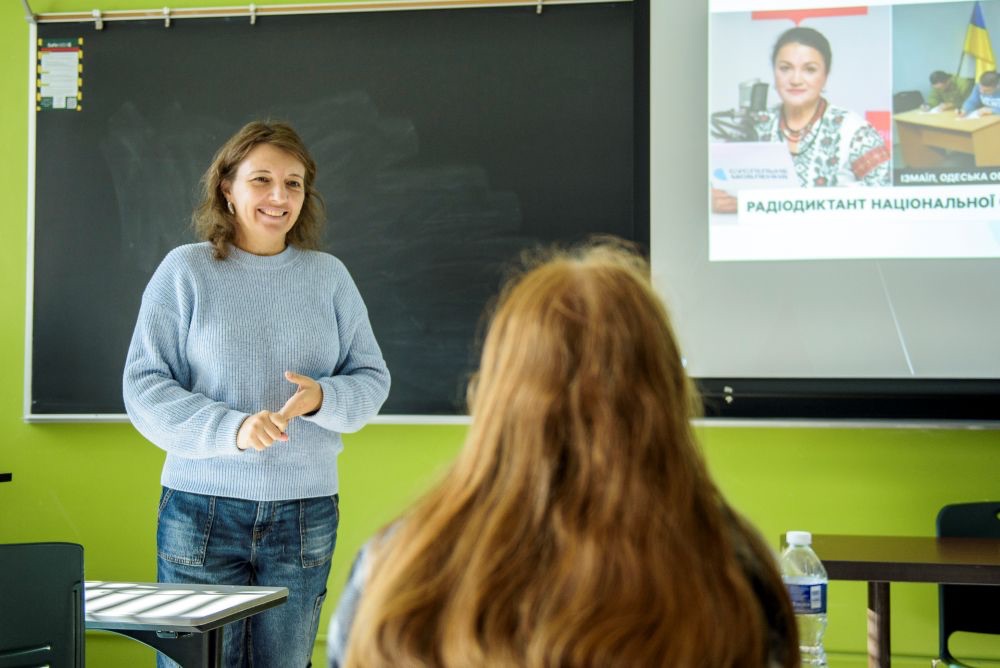
When students walk into the Ukrainian language classroom at Michigan State University, they’re not just learning vocabulary — they’re connecting with a living story of resilience, culture and hope.
That story belongs to Kseniia Borodin, a Fulbright Scholar-in-Residence and expert on folklore studies who teaches at the Ukrainian Catholic University in Lviv and the University of Wrocław (Poland).
Borodin’s arrival to MSU comes at a time when the war in Ukraine continues to devastate and reshape lives and communities. Her presence on campus is more than academic. It’s deeply personal and profoundly symbolic.
“I think that nowadays you can read a lot about Ukraine in newspapers,” Borodin said. “But news gives us only numbers and headlines. I’m here to show the human side of the story.”
With 20 years of experience teaching Ukrainian language both in Ukraine and internationally, Borodin brings a wealth of expertise to her students.
She is the co-author of “Yabluko: Intermediate Ukrainian,” a widely used language textbook adopted by leading universities across Europe and the United States. She also co-authored “1000 and 1 Word,” a vocabulary guide for beginners. In addition, she has consulted for Duolingo and even volunteered her voice for Ukrainian phrases for Google.
Her teaching philosophy is rooted in authenticity and connection: Students begin working with real texts from day one, building sentences and phrases that reflect their own voices and can be adapted to real situations.
She also infuses etymology into her courses, making the learning process easier and more engaging.
“Knowledge of Ukrainian can open doors into so many fields — diplomacy, journalism, history, translation, linguistics and culture — and that’s something I want my students to really feel,” said Borodin. “No matter what careers they pursue, my hope is that they carry with them a lasting interest in and love for Ukraine.”
Borodin’s journey to East Lansing was made possible through a Fulbright Scholar-in-Residence grant. Matthew Pauly, an associate professor in the Department of History and a core faculty member of the Center for European and Eurasian Studies, or CEES, coordinated MSU’s application to the Fulbright program.
Volodymyr Tarabara, director of CEES and a professor in the Department of Civil and Environmental Engineering, and Jason Merrill, associate director of CEES and a professor in the Department of Linguistics, Languages, and Cultures, provided critical backing for the application. MSU’s Office of the Provost, with the endorsement of the Dean for International Studies and Programs, contributed key support.
A visiting scholar appointment with CEES ensured Borodin’s transition was smooth and meaningful. She works closely with Pauly, Tarabara and Merrill on professional networking, teaching mentorship, institutional affiliation — and more.
“Their support has made my experience at MSU richer and really rewarding,” said Borodin. “Campus has been extremely friendly and eager to help. I especially love coming to the office where the foreign language faculty gather. It always has a fantastic, warm and welcoming atmosphere.”
Pauly, a historian of Ukraine, Eastern Europe and Russia, was instrumental in securing the Fulbright grant. He emphasized the urgency and impact of bringing Borodin to MSU during this critical moment in Ukraine’s history.
“Ukraine is now in the eleventh year of war with the Russian Federation,” he said. “American students and the public can best understand the Ukrainian perspective on the war through a personal cultural exchange.”
Beyond presenting her scholarship to the Ukrainian American community in Michigan, Pauly noted that it’s also important to reach those without any Ukrainian roots.
“They stand the greatest chance to learn,” he said. This is particularly important given that, according to Human Rights Watch, “Russian authorities are suppressing the Ukrainian language and curriculum, imposing the Russian curriculum, anti-Ukrainian propaganda and Russian as the language of instruction in schools in areas of Ukraine that Russia is occupying.”
Borodin’s expertise in folklore and Ukrainian instruction made her an ideal candidate for the Fulbright award. Recommended by Sofiya Asher, a senior lecturer at Indiana University and president of the International Association of Teachers of Ukrainian, her scholarship complements MSU’s existing programs in Eastern European studies.
“My scholarship is in Ukrainian history,” Pauly noted. “And we have several faculty members at Michigan State who have leading expertise in Russian language instruction and Russian, Polish, Georgian and Central Asian literature, politics, energy policy, agricultural sciences and media studies. Dr. Borodin’s knowledge and scholarship in the Ukrainian language, folklore and literature complement these existing competencies and will build interest in the region.”
In addition to language instruction, Borodin will teach a course on historical and contemporary Ukrainian culture in the spring.
For Borodin, teaching at MSU during a time of war in her home country is both a personal refuge and an important act of cultural preservation.
“When the full-scale war began, my life, like everyone else’s, changed completely,” she said. “We all had to step up. Volunteering, supporting each other, working beyond our limits. It’s been exhausting, emotionally and physically, but it also showed me the strength and resilience of my people.
“Being here gives me a moment to breathe and share my language and culture safely. I feel immense gratitude that my children and I are here, safe and able to continue our lives while still being connected to Ukraine. That sense of safety and purpose is a reminder of why this work matters — for my students, for my country and for my family.”
Her work at MSU is a testament to the power of education and cultural exchange. In every lesson, Borodin creates a meaningful bridge to Ukraine, not just through grammar and vocabulary, but through stories, empathy and hope.
This story originally appeared on the College of Social Science website.